# hotty
**HTML over the TTY.**
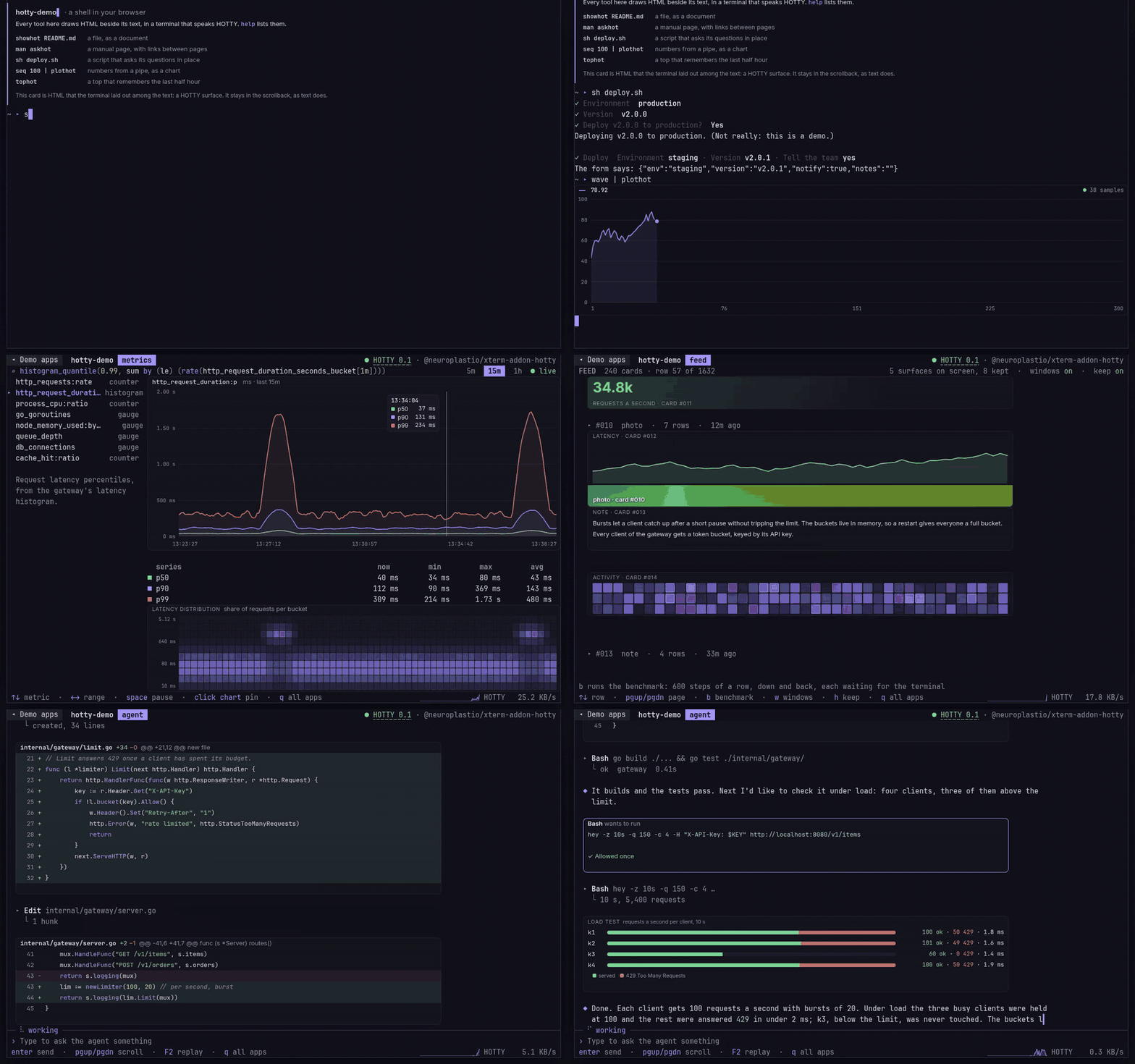
A terminal program prints small HTML documents — **surfaces** — and the terminal
lays them out and draws them into rectangles of cells. No script, no network, no
browser: everything travels in-band, so it works over a pty and SSH, and falls
back to plain text where there is no host.
[Website]() ·
[Docs](https://hotty.neuroplast.io/docs/) ·
[Specification](https://hotty.neuroplast.io/docs/protocol/) ·
[Changes](https://hotty.neuroplast.io/docs/changes/) ·
[Examples](https://github.com/neuroplastio/hotty/tree/main/examples)
## Why hotty
A terminal program has cells: monospace characters with a few attributes. hotty
adds a second kind of output: a **surface**, one HTML document placed on a
rectangle of cells. The host lays it out and draws it at the terminal's own
resolution: proportional type, tables, form controls, SVG, images. Outside it,
everything stays a terminal. Clicks, changes and submits come back to the
program as events on its input.
hotty is designed around four constraints:
- **In-band.** Everything a surface needs travels in the program's output stream.
Nothing is loaded from files or the network, so a program behaves the same
locally, over SSH and inside a container.
- **The program is the application.** Surfaces have no script. The program holds
the state and decides what every event means; the terminal is the view.
- **Deltas, not redraws.** Updates are addressed by element id, so a change costs
what it changes: a live number is tens of bytes.
- **Degrade, never break.** A program detects its host and falls back to plain
cells where there is none.
[How hotty works](https://hotty.neuroplast.io/docs/concepts/how-it-works/) follows one surface from the
program's first byte to the user's click.
## Status
**Version 0.4, a draft.** Versions 0.x may change incompatibly (§15 of the
[spec](https://hotty.neuroplast.io/docs/protocol/)). 0.4 breaks 0.3: keys are named as *myelin key names* 0.1
names them (`ctrl+a`, `arrow_left`, `mod+s`), and a finger can drag in a
program's cells. [`CHANGES.md`](https://hotty.neuroplast.io/docs/changes/) says what changed and how to
upgrade.
Two hosts that share no code pass the conformance vectors:
[hotty-blitz](https://hotty.neuroplast.io/docs/hotty-blitz/), the renderer
inside hottyterm, and
[xterm-addon-hotty](https://hotty.neuroplast.io/docs/xterm-addon-hotty/), for
xterm.js in a browser.
## Quick start
The quickest host is [**hottyterm**](https://hotty.neuroplast.io/docs/hottyterm/),
a terminal built on Ghostty with hotty built in:
```sh
brew install --cask neuroplastio/tap/hottyterm # macOS on Apple silicon
yay -S hottyterm-bin # Arch Linux on x86_64
```
Then run an example in it:
```sh
python3 examples/dash.py
```
Nothing to install? [hotty.neuroplast.io]() is a
hotty program too: the tour, the demo apps and a toolkit of hotty tools, in a
browser through xterm-addon-hotty or natively in hottyterm.
## Where to go next
- **To run hotty programs:** [Choose a host](https://hotty.neuroplast.io/docs/hosts/): hottyterm, a
browser, any terminal with kitty graphics, or plx.
- **To write one:** [Choose an SDK](https://hotty.neuroplast.io/docs/sdks/): Go, TypeScript, Lua, or the
one-file Python client in this repository.
- **To understand it:** the Concepts, starting with
[How hotty works](https://hotty.neuroplast.io/docs/concepts/how-it-works/).
- **To implement it:** the [protocol](https://hotty.neuroplast.io/docs/protocol/), the [SDK design](https://hotty.neuroplast.io/docs/sdk-design/)
every SDK follows, and the [conformance vectors](https://hotty.neuroplast.io/docs/conformance/).
## Repositories
| repository | what |
| --- | --- |
| `hotty` | this one: the protocol, its conformance vectors, these docs and the reference client |
| [`hotty-go`](https://hotty.neuroplast.io/docs/hotty-go/) | the Go SDK: the protocol, `hottytea` for Bubble Tea, `hottyterm` for command-line tools, and `hottytest`, a host for tests |
| [`hotty-ts`](https://hotty.neuroplast.io/docs/hotty-ts/) | the TypeScript SDK, for Node and Bun |
| [`hotty-lua`](https://hotty.neuroplast.io/docs/hotty-lua/) | the Lua SDK: the wire layer, `hotty.nvim` for Neovim and `hotty.plx` for plx scripts |
| [`hottyterm`](https://hotty.neuroplast.io/docs/hottyterm/) | a terminal that speaks hotty natively: Ghostty with hotty-blitz built in, installed with Homebrew or the AUR |
| [`hotty-blitz`](https://hotty.neuroplast.io/docs/hotty-blitz/) | a renderer (Rust, on Blitz) with a C ABI for terminals, and `hotty run`, a polyfill that shows surfaces in any terminal with kitty graphics |
| [`xterm-addon-hotty`](https://hotty.neuroplast.io/docs/xterm-addon-hotty/) | an xterm.js addon: the browser renders each surface in a sandboxed iframe |
| [hotty.neuroplast.io]() | the website: the tour, the demo apps and the toolkit, as one terminal program (native and WebAssembly); its source is not public |
## What is here
| path | what |
| --- | --- |
| [`SPEC.md`](https://hotty.neuroplast.io/docs/protocol/) | the protocol |
| [`SDK.md`](https://hotty.neuroplast.io/docs/sdk-design/) | what a library that speaks hotty for programs provides, in any language: its components, options, defaults and names |
| [`CHANGES.md`](https://hotty.neuroplast.io/docs/changes/) | what each version changed, and how to upgrade to it |
| [`docs/`](https://github.com/neuroplastio/hotty/tree/main/docs) | these docs: choosing a host and an SDK, and the concepts |
| [`conformance/`](https://hotty.neuroplast.io/docs/conformance/) | the conformance vectors: what a host and an SDK must do, as data |
| [`corpus/`](https://github.com/neuroplastio/hotty/tree/main/corpus) | pages that exercise the HTML and CSS a surface is expected to handle |
| [`examples/`](https://github.com/neuroplastio/hotty/tree/main/examples) | programs that speak hotty: a card, a dashboard, a form, a large grid, a game, a menu |
| [`clients/python/hotty.py`](https://github.com/neuroplastio/hotty/blob/main/clients/python/hotty.py) | a dependency-free reference client with SDK.md's whole wire layer, used by the examples and the hosts' tests; `test_vectors.py` runs the SDK vectors against it |
`examples/bubbros.py` needs the game first: `scripts/bubbros-fetch.sh`. Its art
is not ours to publish; it is replaced before anything built on it is.
## Changing the protocol
- **A change to the wire** goes into [`SPEC.md`](https://hotty.neuroplast.io/docs/protocol/) and
[`conformance/vectors.json`](https://github.com/neuroplastio/hotty/blob/main/conformance/vectors.json) together, and both
implementations run the new vectors. A change that breaks existing programs or
hosts needs a new version (§15).
- **Extensions** live in implementations under a vendor prefix (§15). They come
here when a second implementation wants them.
## Licence
- `SPEC.md` and the documentation: [CC BY 4.0](https://github.com/neuroplastio/hotty/blob/main/LICENSE-CC-BY-4.0).
- The vectors, corpus, examples and client: [Apache-2.0](https://github.com/neuroplastio/hotty/blob/main/LICENSE-APACHE).